Login
Login
GAIL Summit 2025
Overview
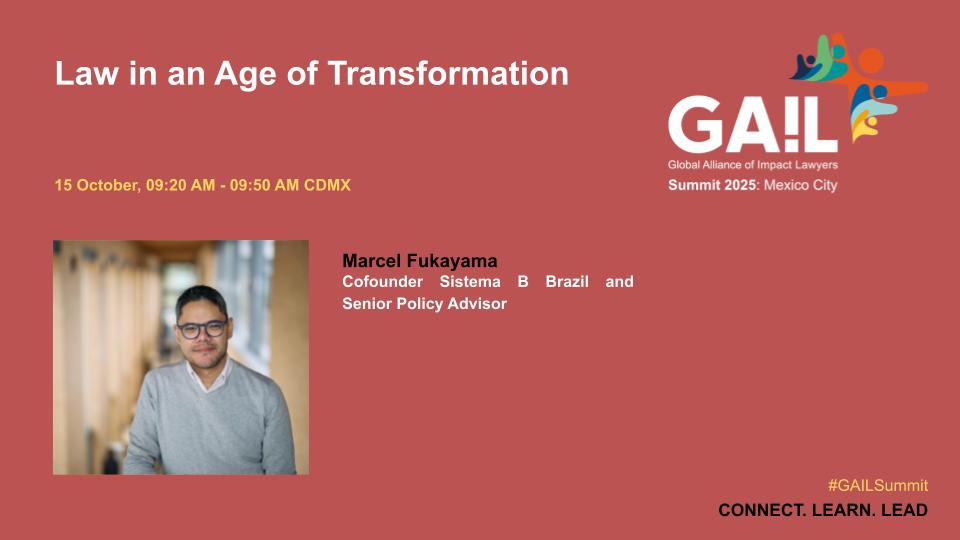
This keynote session addressed the widening gap between traditional legal frameworks and the rapidly evolving social, environmental, economic, and technological conditions shaping the modern world. Marcel Fukayama highlighted how existing legal systems—rooted in stability, precedent, and shareholder-primacy ideology—are struggling to provide relevant, effective responses to crises such as climate change, growing inequality, misinformation, and disruptive technologies like artificial intelligence. Against this backdrop, Marcel introduced the global movement of “impact lawyers” who are reimagining the role of law from reactive risk-mitigation to proactive system design, advocating for legal structures that embed purpose, stakeholder accountability, and transparency into corporate governance. The urgency, Marcel argued, is not simply to update legal tools, but to redefine the legal profession itself as a driver of inclusive, regenerative, and future-fit economic systems.
Law Struggling to Keep Pace with Global Realities
- Marcel argues that traditional legal frameworks are increasingly misaligned with contemporary challenges, including the climate crisis, systemic inequality, economic stagnation, and technological disruption.
- These frameworks—rooted in stability, precedent, and tradition—are poorly equipped to address rapidly evolving global risks, which has resulted in a “crisis of relevance” for the law.
Critique of the Friedman Doctrine
- A central critique focuses on Milton Friedman’s influential 1970 essay “The Social Responsibility of Business Is to Increase Its Profits”, which established a shareholder-primacy paradigm: that a corporation’s primary duty is to maximise profits for its owners.
- Marcel suggests this model has contributed to rising inequality (highlighted by the wealth accumulation of individuals), reinforces short-term profit orientation, and undercuts the potential for law to serve broader social, environmental, and economic justice.
Crisis of Faith in Legal and Economic Institutions
- Because the legal system often reflects and amplifies shareholder-centred capitalism, there is diminishing trust in its ability to deliver equitable outcomes or to support systemic change.
- Furthermore, technological disruption—especially AI—is creating a “hangover effect”: poorly constructed contracts, automated legal processes, and commoditisation of legal services that undermine traditional legal value.
Law as a Catalyst for Transformation
- Rather than viewing law purely as a risk-management tool, the speaker proposes using it proactively to design better systems. This requires a mindset shift among legal professionals: from “harm mitigation” to systemic shaping.
- Lawyers should evolve into “legal systems architects”, actively crafting legal norms that drive long-term, socially inclusive outcomes.
Movement of Impact Lawyers & Transformational Governance
- Marcel highlights a growing network of impact lawyers (including B Lab–aligned practitioners) working to institutionalise legal frameworks that embed purpose, accountability, and transparency into business:
- Purpose: embedding mission-aligned goals into corporate charters, not as optional add-ons.
- Stakeholder Governance: requiring decisions that consider not just shareholders, but employees, communities, environment, etc.
- Transparency & Reporting: measuring, managing, and disclosing impact.
Legal Innovation in Practice
- Benefit Corporation Laws: According to the speaker, more than 50 jurisdictions now have legislation enabling benefit corporations — legal entities that must balance profit with public benefit.
- Capital Markets Innovation: The “Big Corp Index” (a B Lab-linked project) is mentioned, aimed at publicly traded companies that meet impact-oriented criteria — a vehicle to mobilise capital aligned with transformational purposes.
- Public Procurement: Lawyers in this movement are also pushing for public procurement reforms so that government purchasing power rewards positive social and environmental externalities, not just price.
Economic Policy & Institutional Infrastructure
- Beyond formal legal changes, this group of lawyers is building an ecosystem for impact: intermediaries, policy platforms, and capital flows that support businesses driven by purpose and accountability rather than profit alone.
- Marcel underscores that legal change is not just about compliance: it’s about enabling a regenerative, inclusive economic system.
Call to Action
- Marcel invites legal professionals in the room to engage: to shift their identity from conventional lawyer to “architect of legal systems change.”
- There is an appeal to collective action to reshape the rules of the game — through law, governance, and institutions — to build a legally grounded, equitable, and sustainable future.