Login
Esta página fue escrita originalmente en inglés y ha sido traducida automáticamente.
New research from GAIL Latin America explores how legal and regulatory frameworks can support biodiversity conservation, sustainable economic development and investment across nine jurisdictions.
Latin America is home to extraordinary biological diversity and has been the source of some of the world’s most significant legal innovations in the protection of nature. The region has an opportunity to build on this experience to develop economic models in which biodiversity conservation and sustainable development reinforce one another.
How can legal frameworks enable this transition? And where do existing laws, regulations and economic incentives continue to work against it?
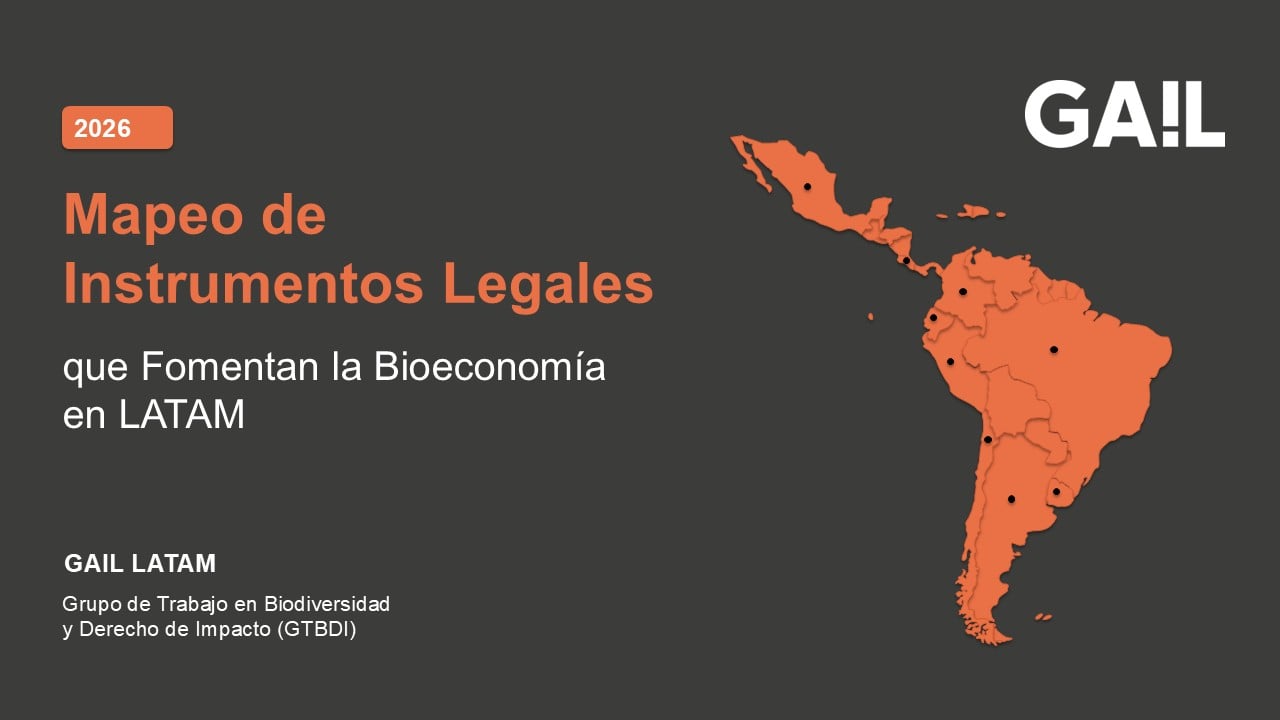
The Global Alliance of Impact Lawyers (GAIL) Latin America Regional Board has published a new report, 2026 Mapping of Legal Instruments Promoting the Bioeconomy in Latin America (Mapeo de Instrumentos Legales que Fomentan la Bioeconomía en LATAM).
Developed by GAIL LATAM’s Biodiversity and Impact Law Working Group in collaboration with the Alianza Latinoamericana de Derecho Ambiental y Sostenibilidad (ALDAS), the 252-page publication brings together legal research from Argentina, Brazil, Chile, Colombia, Costa Rica, Ecuador, Mexico, Peru and Uruguay.
About the research
The report maps existing legislation, regulatory instruments and judicial decisions across three thematic areas:
- Legal innovations and emerging regulatory paradigms: including the recognition of the rights of nature, national biodiversity strategies, international trade provisions, transnational regulation and purpose-driven business models.
- Economic incentives and market instruments: including fiscal incentives, sustainable finance, payments for ecosystem services, biodiversity markets and results-based financing.
- Harmful incentives and structural contradictions: examining subsidies and land tenure frameworks that may undermine biodiversity conservation and encourage ecosystem degradation.
The research highlights how biodiversity is increasingly being integrated into areas of law beyond traditional environmental law, including corporate law, trade, finance, taxation and property law.
It also identifies tensions within existing legal frameworks, where measures designed to promote conservation coexist with provisions and incentives that may contribute to biodiversity loss.
By bringing together experiences across nine jurisdictions, the report provides a resource for legal practitioners, policymakers, researchers and others working at the intersection of biodiversity, law, finance and sustainable development. It also offers a foundation for further cross-jurisdictional learning and collaboration, with relevance beyond Latin America.
A collaborative legal research project
The project was led by Ivana Calcagno and Guillermo Tejeiro through GAIL LATAM’s Biodiversity and Impact Law Working Group, in collaboration with ALDAS.
GAIL extends its thanks to the participating law firms and their teams, whose pro bono research and expertise made this publication possible:
- Argentina: Beccar Varela
- Brazil: Mattos Filho
- Chile: Carey
- Colombia: Cuatrecasas
- Costa Rica: Alta Legal
- Ecuador: Pérez, Bustamante & Ponce
- Mexico: Galicia Abogados
- Peru: Rodrigo, Elías & Medrano Abogados
- Uruguay: Guyer & Regules
Read the report
The full report is available in Spanish.
GAIL LATAM will host an online presentation in early 2027 to explore the research, its findings and implications, and opportunities for further collaboration across the global impact law community.
Get involved
The mapping is intended to be a living resource, informed by the continuing contributions of the legal community.
Legal professionals interested in contributing to future iterations of the research or engaging with GAIL LATAM’s Biodiversity and Impact Law Working Group are invited to get in touch with the GAIL Latam.