Login
Login
GAIL Summit 2025
Overview
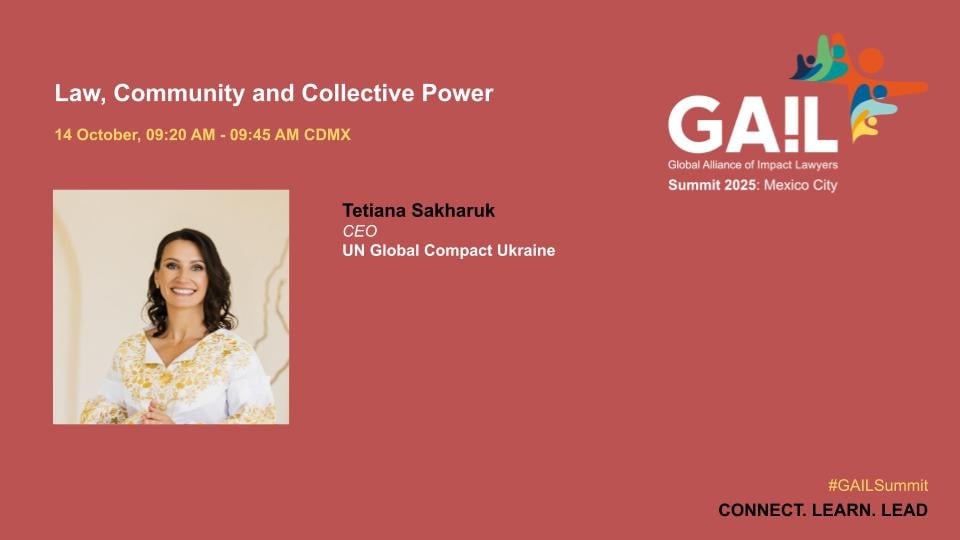
Tetiana Sakharuk, Executive Director of the UN Global Compact Network Ukraine and a former practising lawyer, delivered an address highlighting the vital role of the legal profession and business leaders in strengthening the “social” pillar of ESG — particularly during times of crisis. Drawing on her personal and professional experience since Russia’s full-scale invasion of Ukraine in 2022, Sakharuk explored how purpose-driven leadership and coordinated action can sustain both institutions and individuals amid profound disruption.
Key Themes and Insights
1. The Evolving Focus of ESG: From Environmental to Social Priorities
Prior to the war, Sakharuk and her team had concentrated on environmental initiatives, including launching Ukraine’s largest sustainability and innovation programme on 16 February 2022. Within a week, however, the invasion forced an abrupt reorientation towards the “S” in ESG — the social dimension.
Her message serves as a call to action for organisations — including law firms and corporate legal teams — to integrate social resilience and human welfare considerations into their governance frameworks.
2. Crisis Leadership and Institutional Continuity
Despite the displacement of her team and the loss of infrastructure, Sakharuk ensured the uninterrupted operation of the UN Global Compact Network Ukraine — a first among national networks functioning in active conflict zones. She coordinated staff safety, relocated operations abroad, and maintained programme delivery, demonstrating adaptive leadership and governance resilience.
For legal practitioners, this experience provides valuable lessons in advising clients on crisis management, corporate governance, and business continuity in circumstances of extreme uncertainty.
3. Mental Health as a Corporate and Legal Imperative
Recognising the psychological impact of war, Sakharuk led the creation of a national psychological support platform, providing more than 25,000 therapy sessions to affected individuals. The initiative combined online counselling with in-person interventions such as art therapy, dance therapy, yoga, and mindfulness programmes.
For the legal community, this development underscores the emerging intersection between mental health, corporate responsibility, and employment law. In particular, workplace wellbeing and trauma-informed leadership are increasingly recognised as elements of compliance under frameworks such as the EU Corporate Sustainability Reporting Directive (CSRD).
4. Community Resilience and Social Infrastructure
Working with international partners, including universities and trauma organisations, the UN Global Compact Network Ukraine established community centres in frontline regions such as Zaporizhzhia. These hubs provide safe spaces for social connection, rehabilitation, and psychological support.
Such initiatives demonstrate the practical implementation of ESG values in conflict settings and exemplify how public–private cooperation can sustain communities where traditional humanitarian access is limited.
5. The Lawyer’s Role in Advancing Purpose and Social Impact
Reflecting on her transition from a 17-year legal career to leading a national sustainability network, Sakharuk encouraged legal professionals to view their work as a means of social transformation rather than mere compliance.
Her remarks challenge the profession to act as architects of purpose-driven governance, shaping ethical business practice and social accountability through legal mechanisms.
Key Takeaways for Legal Professionals
- Integrate ESG holistically: Treat the social pillar as central, not peripheral, to sustainable governance.
- Prioritise resilience planning: Legal teams should develop and test crisis and continuity protocols with their clients.
- Embed wellbeing obligations: Recognise mental health as part of employers’ duty of care and ESG compliance.
- Champion purpose in practice: Use legal influence to advance ethical business, human rights, and sustainability objectives.